My first reply to IVC
My first reply to IVC doesn’t answer their letter. It answers what I found in the records they had withheld for four months, which reached me sixty-eight minutes after they told me their review was closed.


Dear [name redacted],
Your response reached me at 16:35 on 22 October and told me that IVC Evidensia's process was concluded. At 17:43 the same day Pride sent me the previously missing June hospital chart, including the anaesthetic record of 11 June, which I had been asking for since July. You concluded a review of Amos's care sixty-eight minutes before I was given the record of the operation it concerns. The questions below require answers.
I expect a substantive response to the questions below within 14 calendar days of receipt. Records directly relevant to Amos’s future treatment were withheld from me for four months. I have waited long enough. If you maintain that the existing complaint process is concluded, register this correspondence as a new complaint and confirm who will respond within that deadline.
Your letter states that "the available operative, anaesthetic and theatre documentation has been supplied", and lists "hospital charts" among what the practice has provided. Those statements were made before the June surgical-admission chart, including the 11 June anaesthetic grid and recovery record, had been supplied to me.
Did the reviewer have and consider the complete June hospital chart, including the 11 June anaesthetic grid and recovery record, before concluding the review? If so, identify when it was obtained and where the findings below were addressed. If not, explain the basis for concluding the review without it, and for the statements quoted above.
Your letter says the clinical history "is intended to provide an accurate and usable account of the information relevant to his clinical care."
Test that sentence against the operation.
"No significant complications." That is [the assisting surgeon]'s note at 21:41 on 11 June, and it is what I was told by telephone at 21:25.
- The nurse's handover at 17:33 lists "Hyperthermia, pain, hypercapnia, hypoventilation RR acidosis".
- The anaesthetic grid shows a temperature of 39.3, end-tidal CO2 to 89, a recruitment manoeuvre at 17:55, repeated fentanyl boluses, and mean arterial pressure in the low 60s during the closing films.
- The anaesthesia record at 12:40: "surgeons reported oozing +++", with a fentanyl bolus. By 14 June his haematocrit had fallen from 66 to 46.7.
- On 18 June, before inducing Amos for the next procedure, the anaesthetist wrote "Hypotension, hypoventilation / Dysphoric recovery" as the problems to anticipate and pre-calculated ephedrine; ephedrine was subsequently administered.
The first three sat in a 58-page chart that reached me on 22 October. None of the four is in any entry of the clinical history.
- Is "no significant complications" an accurate description of the anaesthetic of 11 June?
- If so, please explain how, against the handover list of 17:33, the grid values set out above, and the problems the anaesthetist anticipated on 18 June.
- If not, please say which record is wrong, and whether the 21:41 entry will be corrected and what it will be corrected to.
- If "no significant complications" was intended to refer only to the surgery, where were the anaesthetic complications summarised for the owner and subsequent treating clinicians?
- Under the Practice Standards Scheme (1.2.10), the anaesthetic chart forms part of the clinical record and must include "any anaesthetic complications". The 11 June chart lists them at 17:33. How can the 21:41 history entry say there were none?
- On 18 June the anaesthetist listed "Hypotension, hypoventilation / Dysphoric recovery" as the problems to anticipate and pre-calculated ephedrine; ephedrine was subsequently administered. The 11 June charts record hypoventilation, a mean arterial pressure falling to 61 during the closing films, and a recovery charted as "cry" four times and "unsettled", treated with dexmedetomidine and rectal trazodone.
- Where did she obtain them?
- If from the 11 June anaesthetic record: that record was withheld from me for four months and is referred to in no entry of the clinical history.
- If from a colleague who had been in theatre: why was that information not also summarised in the clinical history?
- If it was a standard list for any spinal case: then she anticipated by habit what the record shows had actually happened, but those previous complications were not summarised in the clinical history.
- Whichever it is, please answer this: where in the clinical history, which you describe as "an accurate and usable account of the information relevant to his clinical care", does a future anaesthetist find that Amos's anaesthetic of 11 June produced hyperthermia, pain, hypercapnia, hypoventilation and respiratory acidosis, the nurse's own handover list at 17:33?
- Where does he find the mean arterial pressure of 61 during the closing films, or the recovery charted as "cry" and "unsettled"?
- Where does he find that on 18 June his pressure fell to a mean of 49 under 1% isoflurane and needed ephedrine twice and a dopamine infusion to hold it? Neither anaesthetic is described in any entry.
- PSS 11.1.3 requires records that let "any veterinary surgeon coming into the practice… proceed with the continuity of care of the patient". What information about the two anaesthetics was actually supplied to subsequent treating clinicians, when was it supplied, and how were the complications identified in that handover?
- The fentanyl infusion was stopped at 17:55, fifteen minutes after its recorded rate doubled, and in the same minute as the recruitment manoeuvre. Who directed the stop, and was it an analgesic decision or a response to the rising CO2?
- The same minute carries the recruitment manoeuvre, with the ventilator rate raised from 22 to 30 and PEEP from 2.7 to 5; end-tidal CO2 fell from 60 to 43 at once and to 31 by 18:16.
- Who performed the recruitment manoeuvre, who directed it, and why at that moment, after more than seven hours with end-tidal CO2 between 49 and 69 (89 and 75 at the move to theatre) and a handover already listing hypercapnia and respiratory acidosis?
- During the 18 June investigation of Amos’s postoperative deterioration - CT, MRI, ultrasound and sampling - he developed recurrent hypotension, with mean arterial pressures of 49–55 at several readings between 16:05 and 16:40. Ephedrine was given twice, followed by a dopamine infusion that was increased. His heart rate during that interval was 104–143. The same day’s blood sample showed CRP 37.2, and that evening the practice recorded “reactive/inflammatory vs infectious”.
- What cause was assigned to the hypotension?
- Was sepsis considered, by whom, and where did that assessment enter the interpretation of the investigations and subsequent treatment?
- If an anaesthetic or volume cause was assigned, identify the clinician and the contemporaneous evidence supporting that assessment. Explain how that attribution accounts for the hypotension that continued after the vaporiser was reduced to 1.0% at 16:08, the heart-rate pattern and the escalation from two ephedrine doses to an increased dopamine infusion. Identify the contemporaneous anaesthetic-depth and volume assessments supporting your explanation.
- What evidence distinguished an anaesthetic or volume cause from infection-related circulatory dysfunction, on a day when the practice's own entry read "reactive/inflammatory vs infectious"?
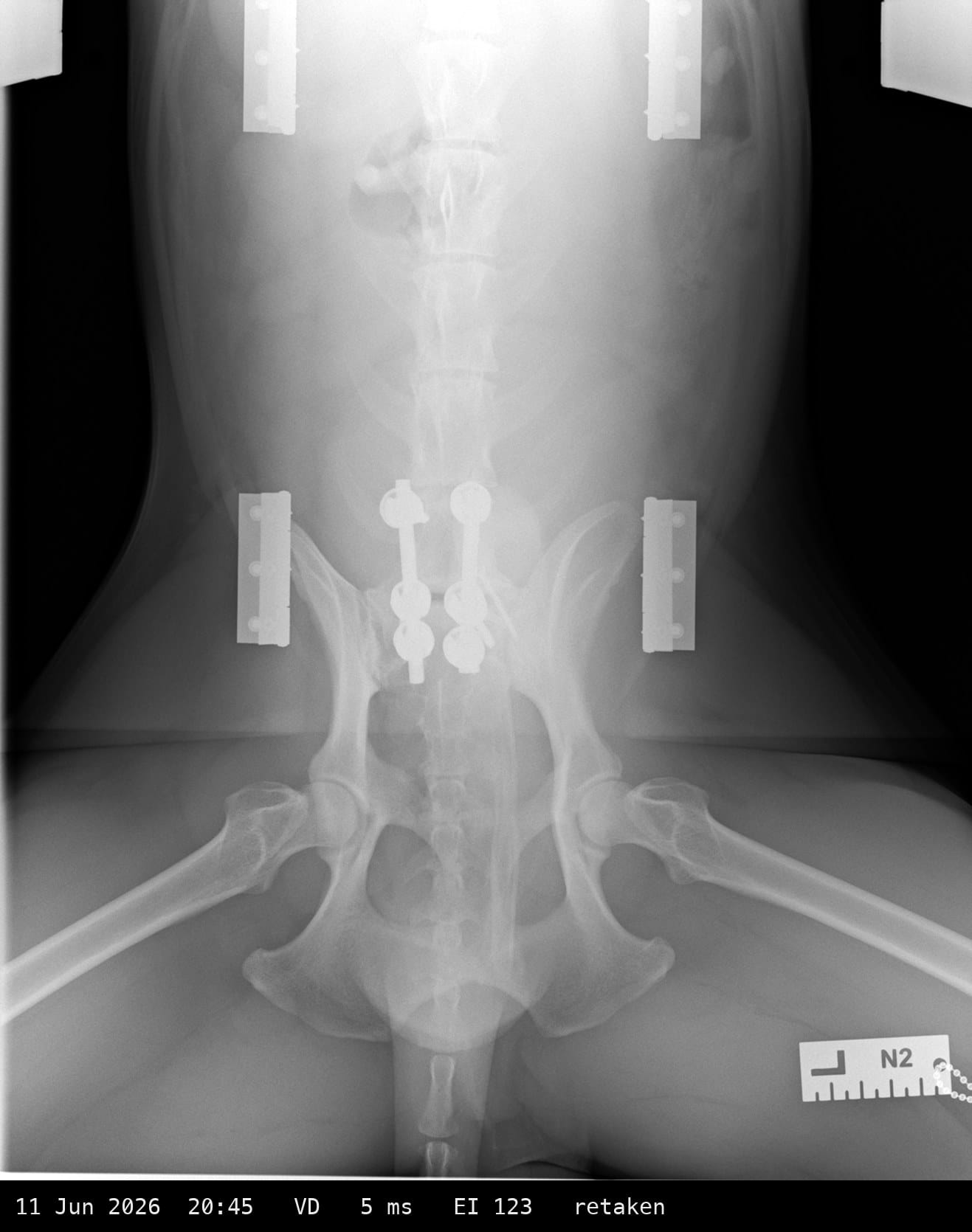
The radiographs, 20:05 to 20:58. Your letter answered the positioning part of my question and attributed the failed films to the pelvic positioner. It did not answer the rest: why several underexposed films were taken at the same setting over that period, and how the two usable films were then taken three minutes apart at the end.
The exposure record answers part of it: a lateral at 1.6 mAs at 20:22, unreadable; three ventrodorsal films at 2.0 mAs at 20:35, 20:36 and 20:45, underexposed; then the setting raised nearly sevenfold, to 10.8 and 14 mAs, and two diagnostic films at 20:54 and 20:57. Same kV, same protocol, same machine throughout.
Your letter says six postoperative radiographs were obtained. The image numbers run from 1 to 9; images 2, 3 and 8 were not supplied. Positioning does not explain the repeated underexposure, or why the exposure setting remained unchanged across three ventrodorsal attempts.
What the grid records across the same period: respiratory rate falling from six breaths a minute to two, end-tidal CO2 of 88 at 20:30, mean arterial pressure of 61, the vaporiser recorded at 2.0% until after the last exposure at 20:57, and no end-tidal agent value charted for those columns when all but one duplicated column from 10:55 to 20:00 has one.
- Obtain accounts from the identified staff who were present, and distinguish their recollections from what is documented contemporaneously.
- Who was in the room?
- PSS 1.2.10 requires the anaesthetic chart to record the "personnel involved". Where on the 11 June chart are they recorded for the radiography?
- Who took the films, and who changed the exposure?
- Where are images 2, 3 and 8?
- PSS 5.1.17 requires an accessible record of all X-ray exposures, including exposure factors, personnel involved and the quality of the resulting images. Please provide the complete exposure log for 11 June, including any rejected or deleted images, and reconcile it with the six images supplied and the image numbers running from 1 to 9.
- Pride's published description of its anaesthesia and analgesia team says they "are responsible for the sedation, anaesthesia and recovery of all patients admitted to the hospital" and "are present at every procedure". Which member of that team was present for the radiography, and where on the 11 June chart is that recorded?
- Who was the veterinary surgeon responsible for the anaesthetic, and were they in the room? If not, why not, and where were they?
- Did anyone leave or enter the room during the films? If so, who, when and why?
- Is what the grid shows acceptable? If so, please explain, using the Association of Veterinary Anaesthetists' published monitoring recommendations and Pride's own published description of its anaesthesia and analgesia team as the reference.
- If not, say why it happened, why I was not told when I was telephoned at 21:25, and why the entry written at 21:41 says "No significant complications".
Regurgitation. At 22:44 on 11 June a nurse entered "R+" and "To start omeprazole" on Amos's chart. At 22:45 the same nurse cleared both. No administration of omeprazole is recorded. An anti-inflammatory was given at 23:54.
- Who was present during Amos's recovery from extubation at 21:08 to midnight on 11 June, and which veterinary surgeon was in charge of it?
- Did anyone leave or arrive during that period? If so, who, when, and why?
- The veterinary traces in that time are the trazodone dispensed under [the treating neurologist]'s login at 21:17, [the assisting surgeon]'s telephone call to me at 21:25, and his history entry at 21:41; every entry on the recovery chart is a nurse's. Pride's published description makes the anaesthesia and analgesia team responsible for the recovery of all patients. Which member of it was responsible for this one?
- What happened between 22:44 and 22:45?
- Who was present, and why was the entry cleared?
- Was this the nurse's own decision or another person's instruction and, if so, whose?
- Did Amos regurgitate, was omeprazole administered, and where were the event and resulting treatment decision subsequently recorded?
- Was the anti-inflammatory at 23:54 given with knowledge of the regurgitation recorded at 22:44?
"Unremarkable." On 14 June Amos's ALT was 841 against a reference range of 10 to 125, and his haematocrit was 46.7 against 66 before surgery. [The assisting surgeon]'s entry at 11:53 says "bloods (unremarkable)". At 19:19 he told me "all blood tests seem normal and I am not concerned". That morning, tranexamic acid was changed to intravenous administration: the 11:00 dose was marked complete at 11:03, and further intravenous doses are recorded on 15 and 16 June. I was told Amos had oedema and to massage it.
- Why were those results called unremarkable, and is "unremarkable" the account a future clinician should rely on?
- PSS 11.1.3 requires records that enable continuity of care. How was a subsequent treating clinician expected to identify and act on these findings when the clinical history described them as "unremarkable"?
- If the results are unremarkable, please explain. If not, why are they recorded as such?
- Why was tranexamic acid moved to the intravenous route on 14 June?
- What was it given for, and why was I told there was no concern?
- The same 14 June entry says "Assessed by [initials A] and [initials B] as well".
- Who are [initials A] and [initials B], what are their roles, what did each of them examine on 14 June, what did they find, what did they advise, and where is it recorded?
- No entry in the 66-page history is signed by either, neither is named anywhere in it, and neither has an event on the June chart. If a senior clinician examined a bleed into the surgical site around new implants and concluded nothing needed to be written, say so.
Trazodone.
| When | Record |
|---|---|
| 11 Jun 17:55 | Fentanyl infusion stopped |
| 11 Jun 18:02 | Methadone 0.2 mg/kg IV, the last intraoperative dose |
| 11 Jun 19:22 | Morphine splash |
| 11 Jun 19:27 | Bupivacaine splash |
| 11 Jun ~20:03 | Trazodone scheduled on the ward chart, while he was still anaesthetised |
| 11 Jun 20:58 | Last readings under anaesthesia: end-tidal CO2 70, mean arterial pressure 63 |
| 11 Jun 21:08 | Extubated |
| 11 Jun 21:17 | A pack of trazodone 150 mg dispensed under [the treating neurologist]'s login |
| 11 Jun 21:20 | Recovery chart: "cry" |
| 11 Jun ~21:37 | Dexmedetomidine |
| 11 Jun 21:42 | "cry" |
| 11 Jun 21:57 | "cry"; trazodone given rectally |
| 11 Jun 22:19 | "cry" |
| 11 Jun 22:20 | Methadone, the scheduled 22:00 dose: 4 h 18 min after the previous methadone, 72 min after extubation, 60 min after the first "cry" |
| 11 Jun 23:58 | Methadone 0.1 mg/kg top-up "as cried when turning" |
| 12 Jun 00:00 | Acepromazine |
- Ketamine continued into recovery and overnight.
- What was the indication and dose for the trazodone given rectally at 21:57, why was that drug and route chosen, and which veterinary surgeon authorised it?
- What assessment distinguished pain from dysphoria or anxiety during the repeated "cry" observations? Who made that assessment, what findings supported the choice and timing of dexmedetomidine and rectal trazodone, and why was no methadone beyond the scheduled dose given until 23:58?
- PSS 15.2.3 requires pain to be "reassessed and recorded regularly throughout surgical procedures and recovery", with "Evidence that this reassessment has led to recorded decisions". Which pain scores were recorded between extubation and 22:20, and what decisions followed from them?
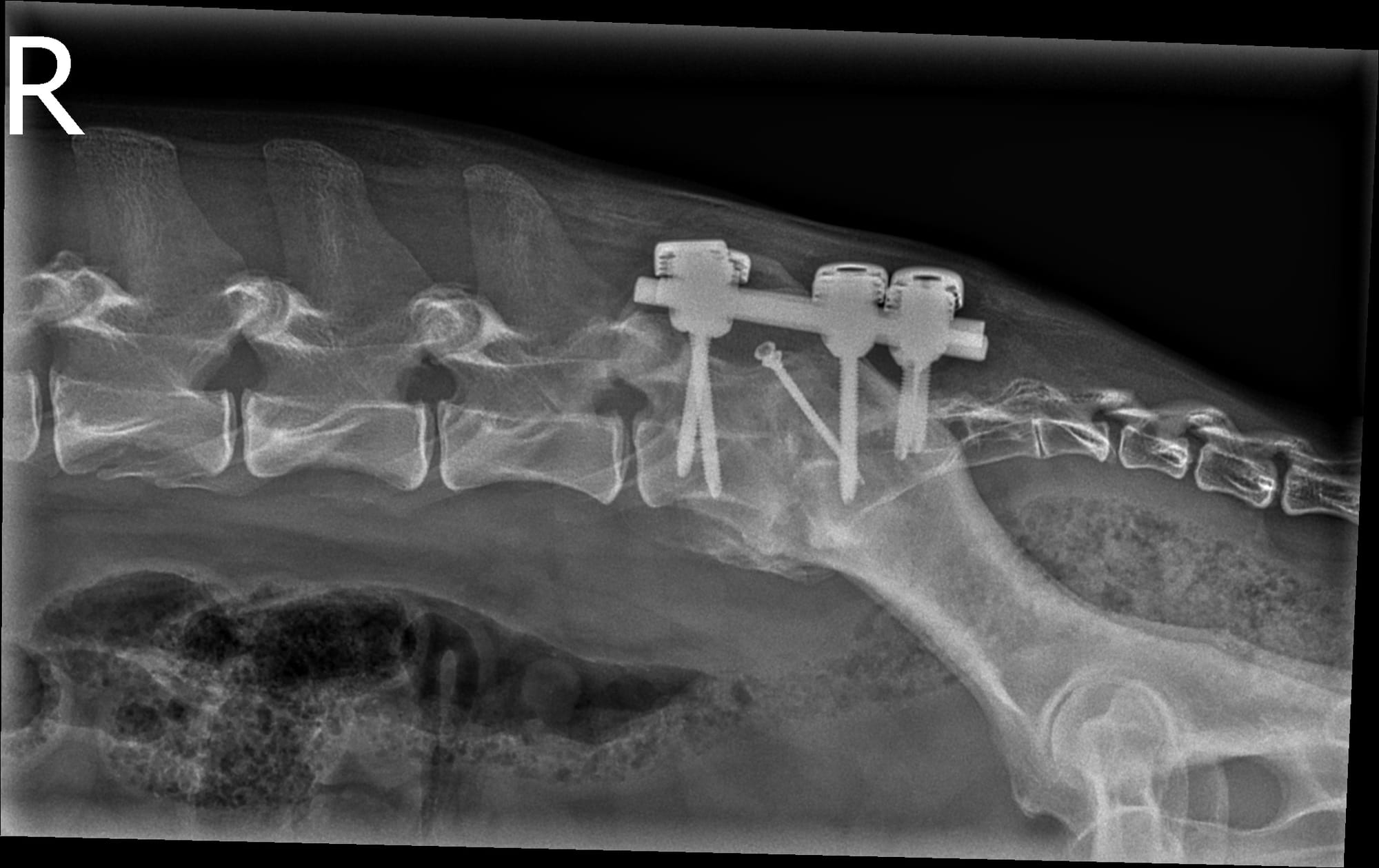
The post-operative CT, 12 June.
| When | Record |
|---|---|
| 10 Jun | Haematocrit 66 |
| 11 Jun 10:14 | Anaesthesia begins |
| 11 Jun 12:40 | "surgeons reported oozing +++" |
| 11 Jun 12:51, 14:15, 16:30, 19:00 | Blood gases: haematocrit 38, 36, 34, 35 |
| 11 Jun 17:33 | Handover: "Hyperthermia, pain, hypercapnia, hypoventilation RR acidosis" |
| 11 Jun, closure | "Laminectomy window covered with lyostip" (operative report, 2 Jul) |
| 11 Jun 20:30–20:58 | Mean arterial pressure 61–73 during the closing films, 61 at 20:30 |
| 11 Jun 21:08 | Extubated |
| 12 Jun 10:22 | Nurse: "Starve in case of post op CT" |
| 12 Jun 10:46 | CT request form created |
| 12 Jun 10:49 | CT request form sent |
| 12 Jun 11:29 | Dexmedetomidine |
| 12 Jun 11:35 | Dexmedetomidine |
| 12 Jun 11:41 | Alfaxalone; first monitoring column |
| 12 Jun 11:45:38, 11:46:02 | CT scouts |
| 12 Jun 11:47:29 | CT acquisition, single, no contrast |
| 12 Jun 11:48 | Alfaxalone; second and last monitoring column |
| 12 Jun 12:00 | Billed "CT - pre/post op (no report)" |
| 12 Jun 12:04 | Heart rate 72, respiratory rate 16, temperature 38.0 |
| 12 Jun 12:14 | Reversal |
| 14 Jun | Haematocrit 46.7, the next blood result |
| 15 Jun | [The assisting surgeon] to me: the left L7 implant "has a mild breach in the canal… to be expected and not concerning" |
- No blood test is recorded between 19:00 on 11 June and 14 June.
- The sedation sheet is under a nurse's login and names no prescribing or supervising veterinary surgeon.
- The pre-operative CT sedation sheet of 10 June has seven columns, every five minutes from 11:20 to 11:50, each recording heart rate, respiratory rate, blood pressure and oxygen saturation, with a temperature at the end. The 12 June sheet has two, at 11:41 and 11:48: heart rate and respiratory rate in both, blood pressure in the second only, and no oxygen saturation or temperature.
- The 10 June and 3 July CTs both have contrast phases.
- The 12 June scan has never been formally reported.
- Who assessed Amos as fit for repeat sedation on the morning of 12 June, what examination and blood results were reviewed, and where is that assessment recorded?
- Were the intraoperative blood-gas results, including the haematocrit measurements, considered, and was further blood testing considered necessary?
- If further testing was not considered necessary, please explain why not and where this is recorded.
- Which veterinary surgeon prescribed and supervised the sedation, and where are their directions recorded? Pride's published description makes the anaesthesia and analgesia team responsible for "sedation for medical investigations and diagnostic imaging". Which member of it was responsible for this one?
- PSS 1.2.10 applies to sedation: the chart must record the personnel involved, the agents with dose and time, vital signs and any complications. Where on the 12 June sheet are the personnel, including the supervising veterinary surgeon, recorded?
- Why does the sedation grid contain only two monitoring columns, at 11:41 and 11:48, with no oxygen saturation or temperature values?
- What monitoring was performed between the final grid entry and the recovery observations at 12:04, and where is it recorded?
- What clinical question justified performing the CT that morning rather than postponing it for further recovery and reassessment?
- Was the intended study confined to implant position, or did it also include assessment of the postoperative tissues?
- Who selected the non-contrast protocol, and was the intended coverage or protocol changed because of Amos's condition?
- What was the scan's conclusion, who interpreted it, and where is that interpretation recorded?
- If the 15 June statement about the left L7 implant's canal breach represents the interpretation, who assessed the breach as "expected and not concerning", on what findings, and why was no formal report produced?
The antibiotic, 12 to 16 June.
| When | Record |
|---|---|
| 31 May | Procedure request: "Antibiotic required: Cefuroxime 20mg/kg. Only for the day of the surgery." |
| 11 Jun 19:52 | An eight-hourly cefuroxime row is entered on the ward sheet by the anaesthesia nurse, while the operation is still in progress |
| 11 Jun 20:00 | First post-operative dose scheduled: cefuroxime 660 mg (6.6 ml), 20 mg/kg; marked complete at 21:12 |
| 12 Jun 09:12 | [The assisting surgeon] sets cefuroxime to continue every eight hours |
| 13 Jun | A veterinary surgeon and a nurse each open a cefuroxime cell and close it without change |
| 16 Jun 12:00 | Fifteenth and last post-operative dose, about three hours before discharge |
| 16 Jun | Discharged with no antibiotic |
| 18 Jun 00:52 | Emergency recheck; readmitted |
| 18 Jun 20:41 | [The readmitting clinician], after CT, MRI and ultrasound: "reactive/inflammatory vs infectious lesions in ST and nerves around LS… Start amox clav whilst pending results." |
| 24 Jul | Pride, of the July admission: "a postoperative infection was not suspected during Amos' hospitalisation here" |
- Every post-operative dose is marked complete by a nurse.
- No clinical entry on any day records the decision to continue cefuroxime, its indication, or a review of it.
- Cefuroxime is a human product used in dogs under the cascade. No cascade consent for it is in the record. The two cascade consents that are in it are for drugs I brought with me.
What the guidance says:
- RCVS supporting guidance on veterinary medicines, 4.46: "Veterinary surgeons must not prescribe an antibiotic for prophylactic purposes, unless it is an exceptional circumstance where the risk of an infection or of an infectious disease is very high and where the consequences of not prescribing the antibiotic are likely to be severe".
- RCVS 4.44: "Antimicrobials must only be prescribed for the most limited period that is consistent with the risk to be addressed."
- RCVS 4.45: "Veterinary surgeons must not prescribe antibiotics to be used: (a) routinely…"
- BSAVA/SAMSoc PROTECT ME poster: prophylactic antibiotics are not indicated for "Postoperative use for ANY procedure unless treating known infection"; "Do not continue antibiotics beyond the day of surgery, unless there is a therapeutic indication".
- The same poster's four therapeutic indications: "To treat a KNOWN bacterial infection… or if there is pre-existing remote infection; Where there is an obvious major break in asepsis…; For 2–3 days postoperatively for open fractures; Until source control has been achieved… for dirty procedures."
- ENOVAT 2025 guidelines, recommendation 16, for orthopaedic procedures with an implant: "we strongly recommend against the use of post-operative surgical antimicrobial prophylaxis."
- RCVS Practice Standards Scheme, Small Animal Modules v3.4, 10.1.28 (Core Standard): "A practice must be able to demonstrate that when using antimicrobials, it does so responsibly and is accountable for the choices made in such use." The document listed for it is a "Protocol for responsible use of antimicrobials and anthelmintics"; what assessors might look at includes "meetings where they created perioperative antibiotic protocol".
- PSS 10.2.3: "The practice has a protocol for antimicrobial use in common conditions encountered." "Assessors will require an example of a written protocol."
- Veterinary Medicines Regulations 2013, paragraph 7A(5), inserted in 2024: "A veterinary surgeon who prescribes a veterinary medicinal product which is an antibiotic must make a record of the satisfaction of the relevant conditions for the purposes of its use in accordance with this paragraph and keep that documentation for at least five years."
- Which published guidance does Pride follow for antibiotic prescribing around surgery? Under the Practice Standards Scheme, an accredited practice is assessed on its protocol for responsible use of antimicrobials (10.1.28) and must have a written protocol for antimicrobial use in common conditions (10.2.3). Please provide both, as in force at Pride in June 2026, and identify where they address antibiotics continued after implant surgery.
- Five days of postoperative cefuroxime departed from the recorded day-of-surgery-only plan and the BSAVA/SAMSoc and ENOVAT recommendations cited above.
- Was it prescribed as treatment or as prophylaxis?
- If treatment: treatment for what? Which of the poster's four therapeutic indications applied, recorded where, by whom? If the 24 July statement also covers June, how is it reconciled with that indication? How long does the guidance say treatment for that indication continues?
- If prophylaxis: state the exceptional risk relied on under paragraph 4.46, where that assessment was recorded, and why [the assisting surgeon] continued it at 09:12 on 12 June without an entry, against a plan that said one day. Where is the record of "the satisfaction of the relevant conditions" for its use that paragraph 7A(5) of the Veterinary Medicines Regulations requires? If Pride's position is that paragraph 7A does not apply to cefuroxime prescribed under the cascade, say so.
- If it was the practice's standard course after spinal surgery: say so, and how that is reconciled with paragraph 4.45(a).
- Where is the cascade consent for cefuroxime? PSS 10.1.24 and 10.1.25 require owners to give informed consent for cascade medicines: "Written forms for signature are expected."
- Was it prescribed as treatment or as prophylaxis?
- If the risk of infection was high enough on 12 June to justify five days of a cascade antibiotic, what changed by 16 June that made it safe to send him home with none?
- Was the readmission of 18 June, within thirty-six hours of discharge, discussed at a morbidity and mortality or significant-event meeting, as PSS 2.3.1 requires such meetings to be held and recorded? If so, when, and where are the minutes?
Urination.
| When | Record |
|---|---|
| 11 Jun 17:37 | Handover: bladder check every four hours |
| 12 Jun 00:00 | Toileting: "Bed" |
| 12 Jun 08:52 | "Some expressed rest passed himself" |
| 12 Jun 14:12 | "Urine very concentrated - neuro aware" |
| 13 Jun 00:14 | Bladder checked with ultrasound: 6 × 6.5 cm |
| 13 Jun 05:50 | "U+++ in bed- bathed" |
| 13 Jun 06:46 | Overnight vet, clinical history: "Passing urine on bed" |
| 14 Jun 06:40 | Overnight vet, clinical history: "Passing urine on bed" |
| 14 Jun 11:53 | [The assisting surgeon]: "Improved neurologically" |
| 14 Jun 15:01 | "Urinating in bed" |
| 14 Jun 22:31 | "U+ bed" |
| 15 Jun 07:24 | Overnight summary, clinical history: "Passing urine outside" |
| 15 Jun 15:12 | "Urine passed in kennel. Changed bedding and inco pads" |
| 16 Jun 06:59 | Discharge morning: "Rinsed HLs as urinated" |
| 16 Jun 16:19 | Discharge entry: "Urinated outside before journey" |
| 17 Jun 04:27 | Pride's note of my call: "laid on his side in urine and hasn't moved from that position all night" |
| 18 Jun 20:41 | IV Co-amoxiclav started |
| 18 Jun 21:00 | "U+ on bed" |
| 19 Jun 06:29 | Overnight summary, clinical history: "U+ on bed and yard" |
| 20 Jun 15:00 | "Passed large u+ in bed and layed in it" |
| 21 Jun 16:00 | "u++ o/s" |
- He was urinating in his bed every day after the operation. No examination entry mentions it. I was not told.
- He was continent again within two to three days of co-amoxiclav being started, and has been since. Amos holds his urine for sixteen hours rather than soil himself; in July he walked outside screaming at every step rather than go where he lay.
- Was a neurogenic bladder after a five-and-a-half-hour dissection over the cauda equina considered between 12 and 16 June, and where is that recorded?
- Was urinalysis or urine culture performed at any point between 11 and 22 June? If not, why not, given urination in bed, "Urine very concentrated" and bladder expression?
- What cause did Pride assign to the incontinence, and what cause to its resolution by 21 June?
- Why was I not told that Amos was urinating in his bed every day after the operation before I was asked to take him home? I would have refused the discharge without hesitation. Since he was toilet trained, until 17 June 2026, he had never gone in the house, let alone his own bed.
- It was in the clinical history on 13 and 14 June. Did the clinician who discharged him read it, and why does no examination or discharge entry deal with it?
A full response to your letter of 22 October follows separately. Nothing in it is conceded by its absence here.
Paul Clegg