Schedule A — Questions and replies
Every question I put to Pride about Amos in July, and what came back. The reassessment criteria went from four, to one (“screaming in pain”), to a suggestion that I define my own.


All questions were put in writing by email while Amos was under the care of Pride Veterinary Referrals, unless stated. Quotations are from the replies. "Not answered" means the point was not addressed in the reply; "Redefined" means the reply changed the criterion rather than applying it.
Round 1 — 12 July 2026 (asked 16:18; reply 23:48)
| Question put | Reply | Status |
|---|---|---|
| Please clarify the reassessment criteria | Four criteria: new neurological deficits; loss of urinary function; persistent deterioration despite treatment; pain severe and unresponsive despite the prescribed plan | Answered |
| Amos squeaks when lowering himself; my vet saw it. Likely cause, and should I monitor it? | "Not unexpected"; tension on healing tissues; monitor for change in frequency or severity; send video | Answered in general terms |
| Is the licking at his groin after lying down linked? | May be associated; "by itself it does not allow us to determine" the cause | Answered in general terms |
| What do you mean by the behavioural aspects of his recovery? | Anticipation of movement, anxiety from previous pain, environment, medication | Answered |
Round 2 — 13–14 July 2026 (asked 13 July 16:13; reply 14 July 09:06)
| Question put | Reply | Status |
|---|---|---|
| Amos could not pass urine for 15–16 hours; he had the urge but posturing appeared too painful. Does that meet "loss of urinary function"? If not, where is the line — how many hours, what signs? | "My advice remains unchanged." Sling advice. | Not answered |
| Which of Amos's specific signs do you consider behavioural rather than pain — vocalisation on standing and lying down, reluctance to toilet, reaction to handling? | "We do not classify individual behaviours as being either 'pain' or 'behaviour'." | Not answered; and contradicted by the 12 July clinical entries |
| For each: who made the determination, when, and on what observations or assessment? | — | Not answered |
| How would I know the difference at home? | — | Not answered |
| If a sign is behavioural rather than pain, it would not change with his pain relief — is that correct? | — | Not answered |
| Which tissues are placed under greater tension when sitting and lying down? | — | Not answered |
| Does that movement also increase tension on the construct, now the disc space has collapsed? | — | Not answered |
| Could the movement-associated pain reflect a mechanical problem not apparent on a static CT? | "Always forms part of our clinical reasoning"; construct failure would show "progressive neurological deterioration together with increasingly frequent and severe pain" | Answered: a criterion was given |
Round 3 — 15–20 July 2026 (asked 15 July 10:54; reply 20 July 10:19; numbered; each point asked to be answered in writing)
| Question put | Reply (from the resident) | Status |
|---|---|---|
| 1. What signs short of an emergency would prompt a recheck or repeat imaging? If none, please confirm | "The only thing that would prompt immediate concerns of imaging would be screaming in pain and a significant deterioration such as the one seen when re-admitted." | Answered: none |
| 2. What defines "loss of urinary function" in practice — inability to pass urine at all, or repeated inability to posture despite the urge? After how many hours? He has gone 15–16 hours once | "Loss of urinary function" restated as urinary incontinence, "a long term sequela"; inability to posture "does not fully get into this category" and "could be normal" for three months. Hours not addressed | Redefined |
| 3. "Severe and unresponsive" — measured how, over what period? If he needs the full rescue plan simply to toilet, is that responsive or unresponsive? | Increase pain relief to maximum "only if screaming in pain is noted". The rescue-plan question not addressed | Not answered |
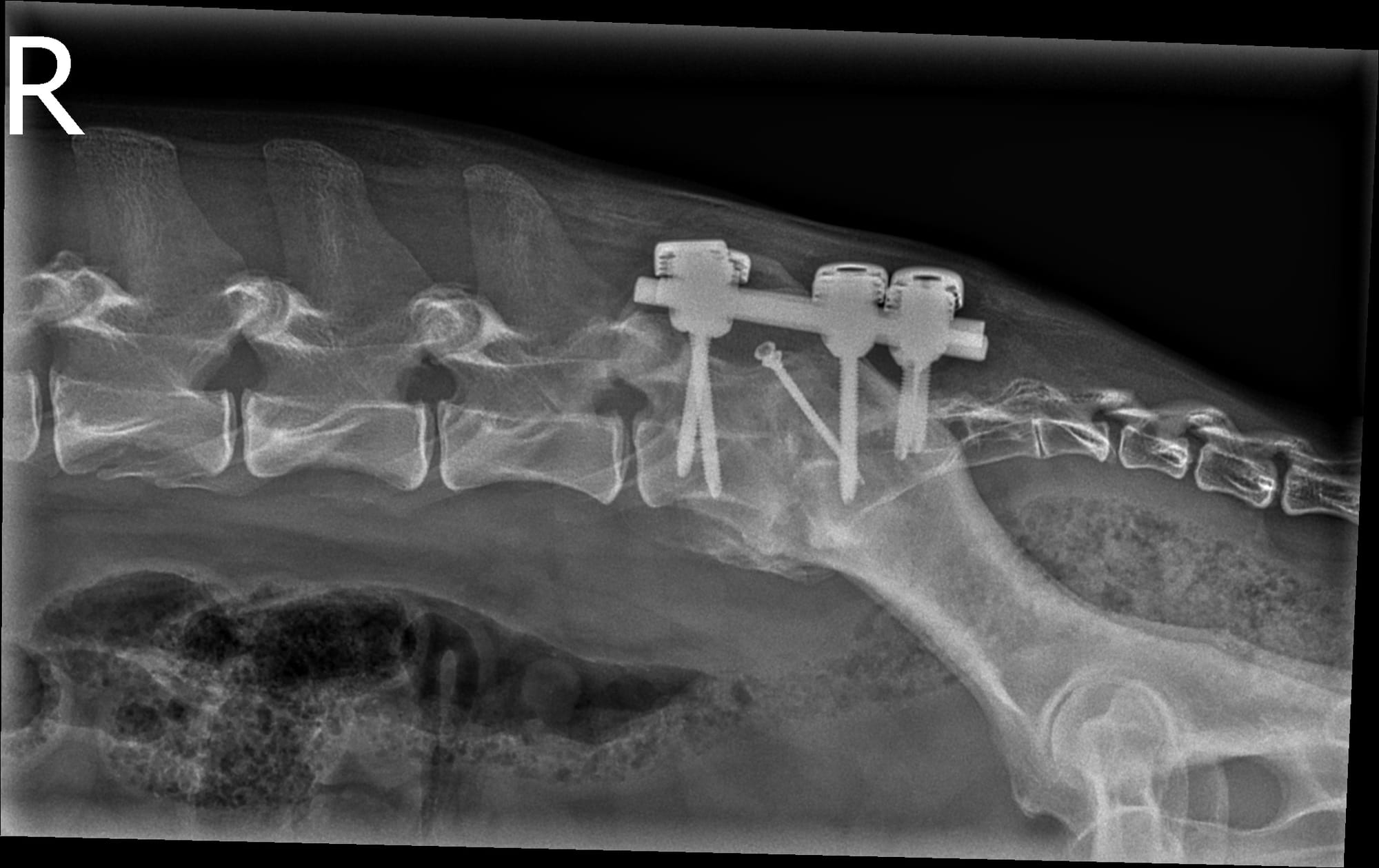
| 4. Is progressive deterioration the only presentation of construct failure you would act on? Would static, significant movement-associated pain, with the documented L7–S1 collapse and displaced S1 screw, ever meet the threshold for repeat imaging? | The collapse and the screw are not mentioned. A new hypothesis (fibrotic retethering) is introduced; the benefit of stabilisation against it is described as "only hypothetical". Trigger restated: "yelping in pain and being unable to handle him" | Not answered |
| Thresholds I can observe and act on: signs, durations, frequencies | "It might be useful to establish the criteria on himself as there are no established general data for this." | Not answered; handed back |
Final reply — 24 July 2026, 12:18, to my email of 21 July 16:28 (signed by the resident, above the head of service's signature block)
| Question put | Reply | Status |
|---|---|---|
| Amos's subsequent deterioration | "Unable to assess this further." | Not answered |
| Duration of the antibiotic course | A matter for the prescribing vet; "a postoperative infection was not suspected" at Pride; follow-up CT showed no enhancement or osteomyelitis | Deflected; infection excluded on CT |
| Repeat CRP | "We cannot recommend repeated CRP measurements as the sole determining factor." I had not proposed it as the sole factor | Not answered; request restated as something else |
| Recommendation of an alternative hospital | Declined as "a potential conflict of interest" | Declined |
| Handover to my primary vet | "I have now re-sent the referral letter (that was initially sent when he was discharged from here)." IVC's letter of 22 October 2026 finds no evidence that anything was sent to Gatehouse Vets before 13 July | Contradicted by IVC's own finding |
25 July — the six questions
Set out in full in section 2 of the letter. None was answered. The reply stated that the issues could not be addressed by email and recommended physical reassessment.
Summary
Across the correspondence the reassessment criteria moved from four, to one ("screaming in pain"), to a suggestion that I define my own. One criterion I reported meeting was redefined so that it no longer applied. The question of which signs had been classed as behavioural, by whom and on what observations, was not answered, and the one test I could run at home — whether a sign classed as behavioural responds to analgesia — was not answered either. The questions put between 12 and 15 July were put while Pride was treating Amos, had examined him, and was liaising with my veterinary surgeon.