Who wrote the review?
IVC Evidensia closed my complaint about Amos’s care on 22 October. This is my reply: who wrote the clinical sections of its letter, why my six questions of 25 July went unanswered, and how the advice Amos was given compares with what the head of service has published on spinal infection.


Dear [name withheld],
Re: Amos — your letter of 22 October 2026 concluding IVC Evidensia's complaints process
Your letter states that IVC Evidensia will have nothing further to add. This letter asks three questions, in sections 1, 3 and 5, and I would welcome answers to them; otherwise it is written for the record and I intend to publish it.
It addresses three things your letter does not: who wrote its clinical sections, why the six questions of 25 July were not answered, and how the advice of 24 July compares with the head of service's own published position on spinal infection. Where I draw an inference I say so, and I set out the documents it rests on. Every document referred to is in IVC's possession or in the public domain, with two exceptions: my recording of the head of service's telephone call of 12 July, and the email from BETA Implants of 20 October. I am happy to share both on request.
1. Who wrote the clinical sections
Your letter says you reviewed my concerns "separately from the practice's initial response" and presents it as answering my request for a review external to the practice. The clinical sections of the letter — on discharge, the pain scores, the six questions, the Liverpool findings and costs — reproduce the phrasing and the arguments of the head of service's emails to me of 12, 14, 24 and 25 July 2026 and of his clinical-history entries of 11 and 12 July. The procedural sections largely do not.
| The head of service, emails and clinical-history entries, 11–25 July | Your letter |
|---|---|
| "the decision to discharge Amos had not been based on a single examination immediately prior to discharge, but rather on his overall clinical progression during several consecutive days of hospitalisation, including resolution of vocalisation, independent mobility, voluntary food intake, normal toileting behaviour" (record, 12 July 12:45) | "The decision to discharge Amos was not based upon any single observation or pain score. The team considered his overall progression over several consecutive days. By 11 July, he was documented as … walking voluntarily, eating his full nutritional requirement, taking his oral medication and toileting independently." |
| "a marked reduction in both the frequency and severity of pain episodes" (record, 11 July 11:49) | "The frequency and severity of the earlier vocalisation had also reduced"; "the frequency and severity of Amos's vocalisation had reduced significantly" |
| "reduced food intake is likely multifactorial, with hospital-related stress likely contributing" (record, 11 July 11:49); "it was not possible to determine with certainty which factor(s) predominated" (record, 12 July 12:45) | "This was likely to have been multifactorial, with reduced nutritional intake, … and possible measurement variation all potentially contributing"; "it is not possible retrospectively to determine precisely how much of the overall reduction reflected genuine tissue loss" |
| "no concerns had been raised during the journey home to suggest a new traumatic event … several factors could potentially have contributed to Amos' reluctance to move, including pain, stress associated with transport, sedation" (record, 12 July 12:45); "may therefore be associated with transient discomfort" (email, 12 July 23:48) | "the prolonged journey home might have contributed to Amos's initial stiffness and reluctance to move"; "In the absence of a reported incident during the journey … more likely to reflect transient discomfort associated with repositioning, the movement of the vehicle or the stress of the journey" |
| "occasional vocalisation during transitional movements, particularly when getting up, sitting down or lying down … On their own, they do not necessarily indicate worsening of his neurological condition" (email, 12 July 23:48) | "occasional vocalisation or signs of discomfort when rising, lying down or repositioning would not necessarily indicate uncontrolled pain" |
| "is not unexpected during recovery following Amos' recent surgery and postoperative complication" (email, 12 July 23:48); "in the context of his recent surgery and postoperative complication" (email, 12 July 14:13) | "His occasional signs of discomfort were not considered unexpected in the context of significant spinal surgery and the collapse of the disc space"; "particularly following significant spinal surgery and the subsequent collapse of the L7–S1 disc space" |
| "I would not interpret this sign in isolation but rather alongside his overall neurological function and clinical progression" (email, 12 July 23:48); "our clinical recommendations are based on the overall clinical trend observed during hospitalisation rather than isolated observations" (record, 12 July 12:45) | Temperature: "would not, in isolation, have indicated pyrexia … The clinical team would have considered it alongside Amos's demeanour, … and the overall temperature trend". Weight: "assessed the weight alongside his appetite, hydration, mobility, toileting and overall progression, rather than treating it as an isolated contraindication". "Pain scores are also not interpreted in isolation." |
| "we interpret them alongside the neurological examination, repeated clinical assessments and, most importantly, Amos' overall clinical progression over time" (email, 14 July) | "clinical decision-making also requires professional interpretation of the patient's behaviour, repeated examinations, response to treatment and overall progression" |
| "she did not identify any new neurological deficits or evidence of deterioration compared with his condition at discharge" (email, 12 July 14:13) | "The information reported did not identify a new neurological deficit or an objective deterioration from his condition at discharge" |
| "remote assessment has important limitations. Videos, blood test results and email correspondence cannot replace an in-person neurological examination" (email, 24 July); "inevitably makes interpretation of the clinical picture more challenging" (record, 12 July 12:45) | "Telephone triage inevitably has limitations, as it is not possible to assess a patient's pain, mobility or neurological function as fully as it would be during a physical examination"; "a review of the written records cannot recreate all the clinical information that would have been available from a physical and neurological examination" |
| "I do not believe it would be appropriate or clinically responsible to … establish a more definitive diagnosis without directly examining Amos" (email, 24 July); "we do not feel it would be clinically responsible to provide further interpretation by email without a physical examination" (email, 25 July 12:27) | "providing a comprehensive differential diagnosis, investigation plan and treatment recommendations for a patient who has not been examined. The latter could not safely or responsibly be completed through email correspondence alone." |
| "do not demonstrate changes that, in themselves, would strongly support" (email, 24 July); "by itself it does not allow us to determine" (email, 12 July 23:48) | "did not, in themselves, provide a strong clinical basis"; "would not, in itself, have contraindicated discharge"; "would not, in itself, be considered inappropriate"; "does not, by itself, establish" (twice) |
| "Having said that, I must emphasise" (email, 24 July) | "Having said that, if you obtain an independent veterinary opinion" |
| "I remain reassured that there has been no objective evidence of neurological deterioration" (email, 14 July); "I cannot identify objective evidence" (email, 24 July) | "I remain satisfied that discharging Amos …"; "I have not identified evidence that …" (five times, six with "any evidence") |
These are not shared clinical idiom. They are the same sentences, re-voiced. Even the assertion frame is his: the letter's "I have not identified evidence" and "I remain satisfied" are the head of service's "I cannot identify objective evidence" and "I remain reassured". Two words have been changed. The head of service calls the L7–S1 collapse a "postoperative complication", in his emails and in his record entries; the letter never uses the word, and it is the "collapse" of the disc space throughout. His "pain episodes" have become "vocalisation".
Whether the head of service drafted these sections or you paraphrased his written comments closely, the result is the same: the clinical defence in a letter presented as an independent review was supplied by the clinician whose decisions were under review. The letter's own words describe the mechanism: you "have liaised with the practice", and for the June questions "obtained further comments from Pride". I ask IVC to state who drafted the clinical sections, and to preserve all drafts and comments exchanged in preparing the letter. The subject access request will show the same thing in due course.
It is worth setting the author of those sections against his own footprint in the record. The clinical history exported on 2 October 2026 runs to 457 entries over 66 pages. Eleven are the head of service's: two trazodone dispensing lines (11 June, 22 June), two attachments, one discussion entry on the morning of discharge recording no examination, and six telephone or correspondence entries, all after Amos had left [pp. 6, 18, 51–52, 56–63]. Apart from the two dispensing entries and the discharge discussion of 11 July, there is no clinical assessment recorded in his name during the three admissions. No examination of Amos is documented under his name on any of the 22 in-patient days. Across the three hospital charts his login appears in none of the 17,970 logged actions. Where he appears in others' entries it is as an assistant credit, a supervision credit, a training rationale relayed by the resident, a discussion credited in the discharge entry of 11 July, and a telephone opinion relayed by the overnight veterinary surgeon at 22:00 on 11 July.
The letter declines to answer my six questions because its signatory "did not examine Amos". The clinical history records no examination of Amos by the head of service either.
2. The six questions of 25 July
Your letter treats the questions of 25 July as the point at which I asked for something that could not be given by email. They were the end of a correspondence, not the start of one. Schedule A — Questions and replies sets out, question by question, what I asked between 12 and 21 July, and what was answered. In short: the reassessment criteria were stated as four, reduced to one ("screaming in pain"), and finally left to me to define; a criterion I reported meeting was redefined so that it no longer applied; the question of which signs had been classed as behavioural, by whom and on what observations, was never answered; and when I asked whether a sign classed as behavioural would respond to analgesia — the one test I could run at home — no reply was given.
The questions of 25 July were written with that correspondence in front of me. They were framed as open questions, and the email asked that if any could not be answered without examining Amos, he say so against that question, name the examination required and say how quickly it should take place.
Your letter says the questions "were not straightforward requests for factual information already contained within the records" and required "an assessment of his pain, mobility, neurological status, hydration, surgical site and general health".
That is not what they asked.
For the record, they were:
- What is your differential diagnosis for a dog who has stopped repositioning himself while lying down and stands only when necessary, in light of the 3–11 July record? If you consider the presentation behavioural, what in that record supports that conclusion?
- Amos has twice shown a functional improvement during antibiotic treatment. I am not suggesting that this establishes causation. What diagnoses is that pattern consistent with, and which does it make less likely?
- Does this pattern warrant investigation to exclude implant-associated infection? If not, please explain why not; if so, how and when should it be investigated?
- Of those diagnoses, which are progressive or become harder to treat if diagnosis is delayed?
- What investigation would distinguish between them — imaging, cultures or otherwise — and on what timescale should it happen?
- Amos's current antibiotic supply runs out on 8 August. Possible osteomyelitis was recorded as a differential on 15 July, and his previous deterioration coincided with the end of an antibiotic course. (a) Is that duration appropriate given that differential, and what should determine it? (b) What should happen when the course ends? (c) Should CRP or another inflammatory marker be measured before or after cessation? None has been repeated since 15 July.
Question 1 is anchored to the 3–11 July record, which Pride held, and asks for the evidence behind a conclusion Pride had already reached without re-examining Amos.
Questions 4, 5 and 6 are answerable from general knowledge by any neurologist. The time-sensitive diagnosis on that list is implant-associated infection; the investigations are imaging, a repeat inflammatory marker and culture; and what should govern the length of treatment for a suspected implant infection, what should happen when it stops, and whether a marker should be measured either side of stopping are questions of principle; on the first two, the head of service's own paper gives answers (section 3).
Question 6 also cites the differential of possible osteomyelitis recorded on 15 July by the veterinary surgeon at Vets4Pets Birstall who examined Amos. I sent the head of service that record at 22:18 on 24 July. He therefore held findings from a veterinary surgeon who had examined Amos and expressly suspected osteomyelitis. Your letter does not address those findings or explain why they were insufficient to inform an answer.
The questions called for substantive answers from the information already available. If any part required a further examination, I had expressly asked the head of service to identify that part, the examination required and its urgency.
Nor does the letter's explanation fit the dates. It says the questions could not be answered because Pride was no longer treating Amos and could not advise on a patient managed elsewhere. The first three rounds of questions in Schedule A, put between 12 and 15 July, were put while Pride was treating him, had examined him, and was liaising with my veterinary surgeon. They were not answered either.
The letter also says the head of service "could not safely or responsibly" give a differential by email. On 24 July he had given one. His email ranks osteomyelitis as not "the most likely explanation", finds no indication for emergency reassessment, and leaves any re-prioritising of the pending referral elsewhere to my own vet after examination. That is a differential, a triage decision and a referral recommendation, by email, on the material he says could not support them. The letter describes that email as "a limited interpretation of specific information". It is the author's own email, re-described after the diagnosis it declined to prioritise was made at Liverpool on 30 July.
Question 3 asked whether implant-associated infection should be investigated to exclude. The email of the day before had addressed only whether it was most likely. Those are different standards, and the easier one was answered.
The letter never mentions the 15 July differential. Nor does it mention the Birstall admission at all; the six days Amos spent there appear only as "a changing clinical presentation being managed by other veterinary professionals". Its discussion of whether infection should have been suspected is confined to the 3–11 July admission, and never reaches 25 July, by which date osteomyelitis had been on the examining vet's differential list for ten days, and in Pride's hands since the night before.
My conclusion, which I state as an inference from these documents: the questions were not left unanswered because answering them required an examination. They were left unanswered because an answer consistent with the head of service's own published position — set out in the next section — would have contradicted the advice given the day before.
3. The 24 July advice against the head of service's published position
The head of service is a co-author of a published case series on spinal epidural empyema in dogs, with authorship credited for manuscript writing and revision. Amos's diagnosis is discospondylitis with implant involvement, not empyema, but in the paper's own series the two travel together: 15 of the 30 dogs had discospondylitis at adjacent levels, and in only 2 was empyema the only finding. I rely on the paper for what its authors say about SEE and, where they say so, about spinal infection generally. Those principles are these.
- SEE is a neurological emergency. Diagnosis is often delayed because the clinical signs are non-specific; the authors say the condition must be considered even when the triad of spinal pain, fever and neurological deficit is not present, and pyrexia was present at admission in only 10% of their cases.
- A delay in diagnosis may allow progression and may be associated with devastating consequences despite adequate treatment.
- CRP should be part of the diagnostic protocol in cases suggestive of SEE; in human medicine it has been shown to shorten diagnostic delay in spinal infections.
- Antimicrobials given before referral may explain a low rate of neutrophilia and may affect culture results.
- The median antimicrobial course was 16 weeks (range 12–20), withdrawn stepwise at four-week intervals, with follow-up MRI advised.
Set against that:
| Published position | Pride's advice, July 2026, and your letter |
|---|---|
| CRP belongs in the diagnostic protocol; shortens diagnostic delay | CRP "non-specific"; may remain elevated after surgery; no repeat advised; a repeat declined "as the sole determining factor", which I had not proposed |
| Pyrexia absent at admission in 90% of confirmed cases | Resolution of fever treated as reassuring (your letter) |
| MRI is the gold standard for spinal infection (sensitivity 96%) | Infection excluded on a follow-up CT that was never formally reported |
| Antimicrobials before referral may affect culture results | Negative cultures treated as not supporting infection (your letter); the swab was taken on 18 June, two days after a six-day course of cefuroxime ended |
| Diagnostic delay may carry devastating consequences | No indication for emergency reassessment; re-prioritising the pending referral left to my own vet after examination |
| Median course 16 weeks, stepped withdrawal, follow-up imaging | Course ending 8 August, about three weeks after it began on 17 July; no repeat marker; no plan for cessation; duration left to "the veterinary surgeon who prescribed them" |
The paper itself calls CRP "a non-specific marker of inflammation" and still says it should be part of the diagnostic protocol. Non-specific is not uninformative: a repeat against a baseline shows direction, and that is what question 6(c) asked for.
I do not say that Amos's case is the paper's case. I say that the standard applied to Amos in Pride's two emails of 24 July, one signed by the head of service and the other sent above his signature block, is lower, on each of these points, than the standard he has put his name to in print.
Amos received cefuroxime from 11 to 16 June and co-amoxiclav from 18 June to 2 July. He was readmitted within 48 hours of each course ending. From 3 July until the morning of 17 July he received no antibiotic: nine of those days as an inpatient at Pride, during which his temperature exceeded 39.0°C on five consecutive days, peaking at 39.6°C, he lost the ability to cock his leg, and a nurse recorded his surgical site as hot to the touch on 6, 10 and 11 July, the last on the morning of discharge. During that admission, Pride's own records show his weight falling by 5.5 kg. On 15 July the veterinary surgeon who examined him at Birstall recorded a differential of possible osteomyelitis. Antibiotics were restarted at Birstall on 17 July and he improved. His CRP was 37.2 on 18 June, two days after cefuroxime stopped and before co-amoxiclav began; 32.5 on 3 July, one day after stopping; 50.4 on 13 July and 51.3 on 15 July, after eleven and thirteen days without; 12.1 on 28 July, eleven days into treatment; and 9 on 1 October. Pride measured it twice in that sequence, and not after 3 July.
Half the dogs in the head of service's study also had adjacent discospondylitis. In dogs whose MRI suggested empyema, the authors accepted response to antibiotics as one means of confirming the diagnosis. The anatomical distinction does not make antibiotic response irrelevant to suspected discospondylitis. My question asked what Amos's repeated response was consistent with and whether it warranted investigation—not whether it proved infection by itself.
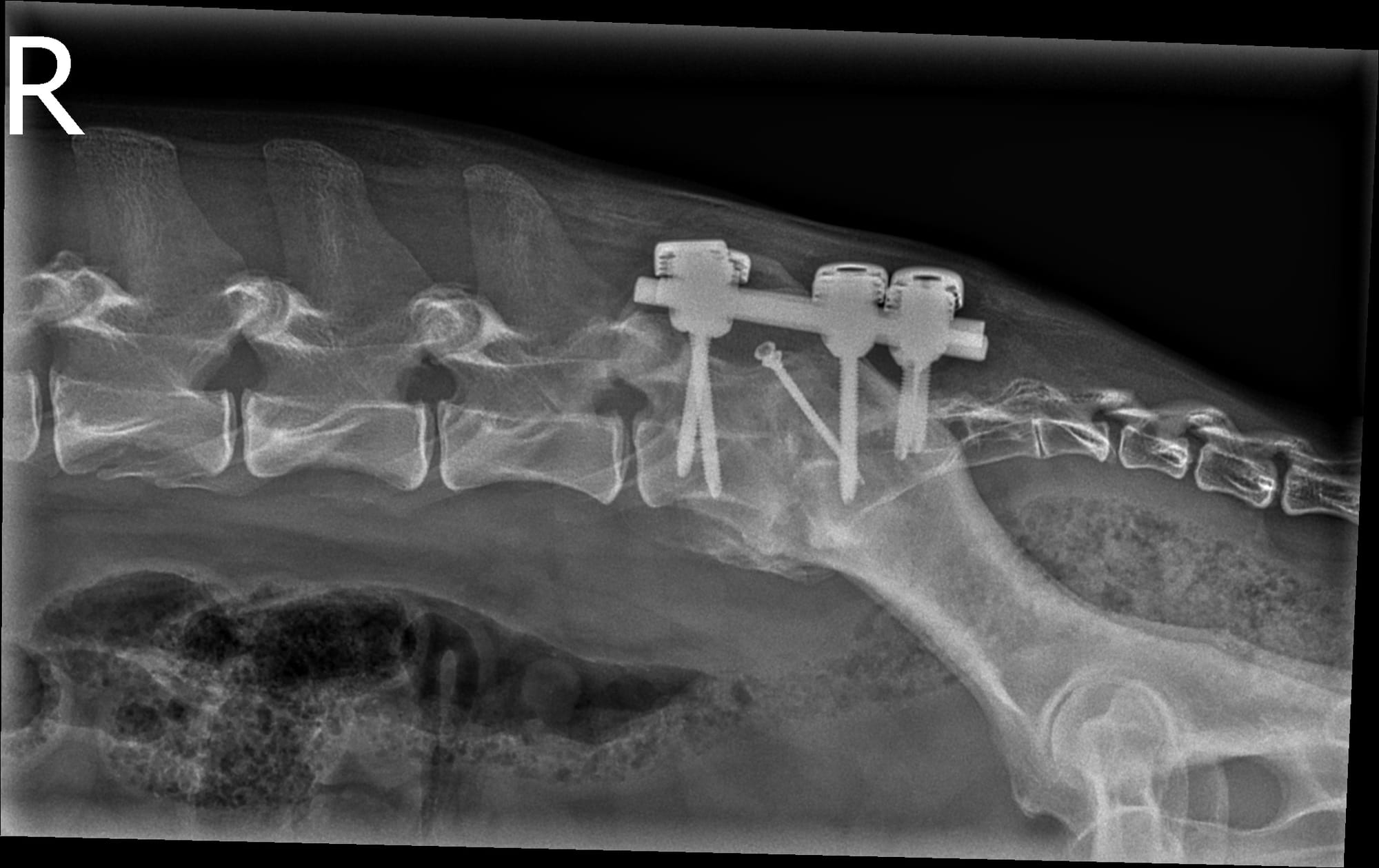
The same paper identifies MRI as the gold standard for diagnosing spinal infection. On 3 July Pride performed radiographs and a CT. The CT was never formally reported, but Pride’s own clinical note records the central findings: the right S1 screw was “displaced dorsally by approximately 1–2 mm”, S1 had shifted relative to L7, and the disc space had collapsed. The scan request named the provisional diagnosis as “Surgery complication (implant failure) vs other”.
Pride’s note identifies movement of one screw: the right S1 screw displaced dorsally by 1–2 mm. Set beside the 12 June CT, the 3 July study shows another, which the note does not record: the screw heads had slid along both rods, leaving more of the rod ends projecting beyond them. It needs no measurement to see. Liverpool subsequently documented slipping at the screw–rod connections and secondary collapse of the disc. The L7–S1 space had closed, and the heads had travelled along the rods that were to hold them.
Pride’s operative report describes transarticular screws across L7–S1 and a monoaxial pedicle screw system from L7 to S2. The stabilisation was intended to hold that space open and prevent movement between L7 and S1. The 3 July note records “mild collapse of the L7–S1 disc space” and a “mild ventral step of S1 relative to L7”, yet concludes “no implant failure”. Nothing had snapped. But a construct that has let the space close and a screw move has not held its fixation, and holding it was its purpose.
Your letter repeats the same distinction: it acknowledges “slight movement of the right S1 screw” while stating that “the remainder of the construct was considered intact”. What to do about those changes was a matter of clinical judgement. Whether a screw has moved and whether a disc space has closed are not. They are measurements on two scans Pride holds, and the answer is the same whoever takes them. Describing the components as intact does not explain the loss of the position they were placed to maintain.
Your letter says you reviewed the correspondence and the contemporaneous clinical records. Its account of the June radiographs turns on what "the available images suggest". It offers no reading of the July CT, only how the construct "was considered". Did you look at the 12 June and 3 July studies yourself, or rely on Pride's description of them?
Set that CT beside the head of service's own entry on the morning of discharge, 11 July at 11:49, his only clinical note during any admission. On the L7–S1 step: "the pedicle screw fixation continues to provide sufficient mechanical stability despite the observed complication." On fusion: "formal arthrodesis was not the surgical objective", "the biological conditions required for interbody fusion had not been created", and "long-term stability is expected to rely primarily on the pedicle screw construct rather than complete vertebral fusion." Put infection to one side entirely. On Pride's own account, a five-year-old dog whose spine had not been prepared to fuse, and whose stability for the rest of his life was to depend on the construct alone, was discharged eight days after a CT on which that construct had moved. The entry records that "the owner appeared reassured". During the discharge I remember saying "I haven't got a choice, I'm taking him home and crossing my fingers".
Pride's record and correspondence, and your letter, offer a separate explanation for each finding. The weight loss was "multifactorial". The temperatures above 39°C were met with a fan, and your letter calls 39.2°C "at the upper limit of the recognised normal" range. The reluctance to move was "behavioural". The crying was "anxiety associated with handling" and "the environment in which they occur", amplified by "the owner-patient interaction". The collapse of the disc space was "trauma", a noise heard at home. The raised CRP was "non-specific" after surgery. The improvement on antibiotics was "the passage of time". Calling the reluctance to move behavioural does not explain the endplate destruction. Calling CRP non-specific does not explain its rise from 32.5 to 51.3. Attributing improvement to the passage of time does not account for the repeated association between deterioration and the end of antibiotic treatment. Every finding has been given its own frame. Nobody has watched the movie.
Infection fits every finding, in the order they occurred, and was the explanation recorded by the vet who examined him at Birstall on 15 July. I do not say Pride's clinicians could not have been right about any one of these. I say that seven separate explanations for seven findings in one dog over three weeks is not a diagnosis, and that the single explanation accounting for every one of them was the one the team had published on.
The period from 3 July to the morning of 17 July was Amos's longest interval without antibiotics after surgery. It encompassed severe pain, substantial recorded weight loss, repeated temperature elevations and a surgical site recorded as hot to the touch. Antibiotics were restarted on 17 July and he improved. I infer that infection was progressing during that untreated interval, rather than first appearing when the later images revealed it.
Your letter says that when Liverpool examined Amos, “almost three weeks later”, the picture “had significantly progressed”. For thirteen of those nineteen days he was on co-amoxiclav, and by 28 July his CRP had fallen from 51.3 to 12.1. The later appearance of destructive changes therefore cannot simply be treated as evidence that the infection developed after Pride’s involvement ended. It must also be read against the preceding fortnight without antibiotics, nine days of it as Pride’s inpatient, and the delay in radiographic signs your letter acknowledges.
The head of service is also a named author of a case report presented under the Pride Veterinary Referrals and IVC Evidensia names (poster, September 2024) describing stabilisation of an L7–S1 subluxation secondary to discospondylitis with the BETAM pedicle screw-rod system. The manufacturer, BETA Implants, has confirmed to me in writing that the products very likely used in Amos's surgery were its 3.5 pedicle pin, ring, cup and locking systems with 3.5 cortical locking screws — components matching those the poster describes — and that Pride can provide the record of which products and batches were used. The poster describes the implant's locking mechanism as of "extreme importance" because infection increases the risk of implant loosening: the device is presented as designed to hold where infection is present. It records that surgery had initially not been recommended because of the risk of implant failure, and that long-term antibiotics are the primary treatment. It also records that when that patient's first antibiotic course was discontinued, clinical signs relapsed and were attributed to another cause, which delayed further investigation. In that patient, mild displacement of the right transarticular screw was found on radiographs, and a repeat CT was also performed at 16 weeks.
Set against Amos, in whom no infection had been found before surgery: movement of the right S1 screw and collapse of the disc space were recorded before discharge, in an implant its authors present as resistant to loosening even in the presence of infection; a differential of osteomyelitis on 15 July; his earlier deterioration had coincided with the end of an antibiotic course; and the questions asking whether this warranted investigation to exclude implant-associated infection, and how long the antibiotics should run, were not answered. The risk, the relapse pattern and the delay that his own case report describes were the ones in front of him. By 30 July Amos had severe discospondylitis at the instrumented level. The infection the implant was presented as able to withstand was one that had not been found in Amos until after the implant was placed.
4. What the letter concedes
For the record, and in the letter's own words or close to them, IVC Evidensia has now accepted the following.
- Hydrotherapy on 8 July was carried out after consent had been withdrawn. There was no further individual authorisation of the session. The only consent relied upon was the one I had withdrawn.
- No written handover was sent to Gatehouse Vets before discharge, despite my specific request. Amos was admitted to Gatehouse on the morning of 13 July, after his emergency presentation at Aireworth on 12 July. The first record Gatehouse received of his admission at Pride was the nursing chart, which I emailed to them myself at 09:16. Pride's referral letter followed at 11:15.
- The practice's earlier statement that Amos's crying had resolved from 6 July was "expressed too definitively" and did not fully reflect the nursing chart.
- Before discharge on 11 July, imaging showed collapse of the L7–S1 disc space, mild ventral displacement of S1 and slight movement of the right S1 screw.
- Amos's recorded weight fell from 34.7 kg on 3 July to 29.2 kg on 10 July, and it is "not possible retrospectively to determine" how much was genuine tissue loss.
- Temperatures above 39.0°C were recorded on several occasions between 5 and 9 July and were treated with cooling measures; no antimicrobial was started.
- Negative cultures cannot exclude infection in every case. It is "possible that the infectious process was developing before it became radiographically apparent".
- The six questions of 25 July were not answered individually, either that afternoon or subsequently.
- The hospital director had "some involvement in administrative decisions relating to costs" before coordinating the practice-level review.
- The clinical record misidentified Aireworth Vets as Amos's primary practice.
- A second pack of trazodone was dispensed at 21:17 on 11 June, the first having been dispensed on 10 June, and Pride cannot say why the second pack was dispensed.
- The supplementary notice I requested was not added when first asked, and was not included when the records were shared with other providers.
- A new injury in transit on 11 July could not have been excluded without examination.
Most of these are followed in the letter by a statement that it did not cause the outcome. I note that the letter never finds that the care was appropriate. Its highest word is "reasonable", each time measured against "the information available" to the team at the time, and its other findings are that I have not proved the contrary.
Four further statements in Pride's correspondence and records are contradicted by its own record, by your letter, or by a third party.
- On 14 July the head of service wrote: "we do not classify individual behaviours as being either 'pain' or 'behaviour'." The clinical entries of 11 and 12 July, which remain unaltered, do exactly that.
- On 24 July Pride wrote that the referral letter had been "initially sent when he was discharged from here". Your letter finds no evidence that anything was sent to Gatehouse Vets before 13 July, only after Amos had been admitted to Gatehouse for the day.
- Your letter states that "the available implant information has been disclosed". In response to my request for implant traceability, Pride stated on 2 October 2026 that it does "not trace consumables to the extent that the client is asking for". The manufacturer states that the clinic orders the materials for each surgery, that it keeps no record of which implant or batch was used for a patient, and that Pride can provide this. Pride's response dated 18 August and sent on 20 August said that the surgery was captured via a kit list and consumable charges. No party has produced a record identifying the batch of the implants placed in Amos on 11 June. For a novel implanted device that is now the site of a severe infection, either that record exists and has not been disclosed, or it was never made.
- Pride’s note of the radiograph review on 28 July, “performed by myself and [the head of service] as supervisor”, records osteolytic changes in both endplates, attributes them to trauma, and concludes that there is no sign of osteomyelitis. It records no advice on antibiotics. Gatehouse’s note of the same call records that Pride “feels antibiotics are no longer required as there is no sign of infection in the bloods at all”; it describes “very minimum movement”, put down to “the secondary trauma”, and plates that “have not moved compared to the initial post op x-ray”. The treatment advice your letter says Pride could not give is absent from Pride’s record of the call and present in the receiving practice’s; and the implants said not to have moved are the ones Pride’s own note of 3 July records as displaced.
The entries of 12 July attributing Amos's presentation to behavioural and owner-related factors were recorded at 14:02, after a telephone discussion with the examining veterinary surgeon. At 11:26 that morning, before any examination, the head of service had put the same explanation to me by telephone, had told me it would be "very easy" for him to call it behavioural and that he was not doing so, and had said that he had to assume Amos was in pain. The plan recorded at 14:02 as agreed with the examining vet — codeine back to the standard dose, the rescue medication simplified and memantine stopped, and a return to his baseline medication — is the plan he told me on that call he intended to propose.
On 30 July, the day Liverpool diagnosed severe discospondylitis, Gatehouse Vets ended its relationship with me, citing conduct that appears nowhere in its clinical record for Amos, exported at reception on 29 July, or in its response to my subject access request. Gatehouse Vets is an IVC Evidensia practice. Your letter refers to it as Amos’s primary practice throughout and does not say so. Asked for the dates, incidents and records relied upon, the practice replied that the decision followed “a pattern of interactions over a period of time”, had been discussed “with the members of staff involved”, and that it did not consider it “appropriate… to provide further particulars”. The termination letter also stated: “We understand that you have also been informed by the referral practice that they are no longer able to continue providing services due to similar concerns regarding interactions with their staff.” I had received no such communication. Pride had acknowledged my formal complaint the day before. The veterinary surgeon who had treated Amos since he was a puppy telephoned me in early August unaware of any of it.
5. Conclusions
I draw eleven conclusions. Each is an inference from the documents set out above, and each can be tested against them.
- The clinical sections of the letter were supplied by the head of service, either as drafted text or as comments reproduced with minimal change. The review of his decisions was, in substance, his own. The clinical history records no examination of Amos by the head of service on any of the 22 in-patient days.
- The letter's account of the six questions is inaccurate. They called for substantive answers from the information already available: Pride's own record, general clinical principles and the findings of the vet who examined Amos at Birstall on 15 July, which Pride held from 24 July and the letter does not address. If any part required a further examination, I had expressly asked the head of service to identify that part, the examination required and its urgency. The explanation that Pride could no longer advise also fails to explain why earlier questions had gone unanswered while Pride was treating Amos.
- The letter's description of the 24 July email as "a limited interpretation" is the author's re-description of his own differential, triage and referral advice, made after that advice was overtaken at Liverpool.
- The advice of 24 July fell below the standard its author has published under his own name, on CRP, on the significance of absent fever, on culture-negative infection, on the cost of diagnostic delay and on antimicrobial duration.
- Before Amos was discharged, Pride's own imaging showed that the fixation had moved, and Pride's own scan request named a provisional diagnosis of implant failure. The letter repeats Pride's description that the construct was "considered intact", but supplies no independent interpretation of the movement shown on the images.
- Infection was progressing during the interval without antibiotics from 3 to 17 July, which included the last nine days of Pride's admission and the discharge. Pride's record explains each finding of that interval separately; no explanation it offers accounts for the course.
- The 12 July entries present, as the outcome of a discussion with the examining vet, an explanation and a plan the head of service had already put to me by telephone before that examination took place.
- Three principles in your letter are applied in one direction only. (a) Findings are not read in isolation. Your letter says so, then answers the findings against discharge one at a time: the weight “alone does not determine suitability for discharge”; the temperature “would not, in isolation, have indicated pyrexia or contraindicated discharge”; the discomfort did not “independently” contraindicate it. Nobody suggested that any one of them did. The question was what they meant together, when his disc space had collapsed and his fixation had moved. Your letter relies on the improving temperature trend, ending at 38.1°C on the morning of discharge, but does not address the nurse’s observation that same morning: “sx site still hot to touch, normothermic”. Your letter says the whole picture was considered. It does not say what the whole picture was. (b) Objective evidence. Where the objective record pointed against discharge, your letter says clinical decision-making "also requires professional interpretation". Where I asked for reassessment, the test became "objective evidence" and "an objective deterioration". (c) Remote assessment. Your letter says telephone triage "inevitably has limitations", and that without examining Amos, the head of service could not "safely determine which possible diagnosis was most likely". At 22:00 on 11 July, by telephone, with Amos at home, he considered the presentation "more consistent with behavioural reluctance to move rather than uncontrolled pain" and did not recommend further analgesia.
- Advice on a patient managed elsewhere. Your letter says the questions of 25 July could not be answered because Pride was no longer treating Amos, and responsibility lay "with the veterinarian directly assessing him". On 28 July, without examining Amos, the resident reviewed my vet’s radiographs with the head of service as supervisor, recorded osteolytic changes in both endplates at L7 and S1 and attributed them to trauma, recorded that “it appears clear that there is no sign of osteomyelitis”, and, by Gatehouse’s record of the call, advised that “antibiotics are no longer required”. Your letter calls that "interpretation of defined diagnostic material". Advising that antibiotics be stopped is not interpretation. It is the "treatment advice" your letter says Pride could not give, and the answer to question 6, given to another practice three days after it was declined to me. Liverpool diagnosed severe discospondylitis two days later. Bilateral endplate osteolysis at an instrumented disc space is the radiographic appearance of discospondylitis, and “delayed radiographic signs”, the note’s explanation for its timing, is the explanation infection gives. The note describes the diagnosis and names it something else. CRP of 12.1 after eleven days of co-amoxiclav, down from 51.3, is a marker falling on treatment; it was read as the absence of infection and the treatment was advised to stop. This goes beyond the inconsistent application of principles set out in conclusion 8. It is the question I asked, declined on 25 July, answered to another practice on 28 July, and answered wrongly. It is the measure against which the rest of this letter should be read.
- In my experience, nothing Amos did could have disproved Pride's account of him. Improvement was expected recovery; deterioration was trauma, the journey, sedation or behaviour. A rising CRP was "non-specific"; a falling one had "come down nicely". Improvement on antibiotics was "the passage of time". The reassessment criteria went from four to one, then to criteria I was to establish myself, and the one I reported meeting was redefined. On 25 July I wrote that no criterion had ever been stated by which the entries about me could be shown to be wrong. None has been since.
- By the evening of 28 July the last clinical entries in the two IVC Evidensia records that any new practice would have received recorded, between them, that Amos “isn’t appearing like a dog in pain”, that the implants had not moved, that antibiotics were not required, and that the Liverpool referral might be attended “to settle his mind”. Two days later Gatehouse ended its relationship with me on grounds its own record does not contain, and has refused to particularise: asked for the dates, incidents and records relied upon, the practice replied that it did not consider it “appropriate… to provide further particulars”, that the decision rested on “a pattern of interactions over a period of time”, and that it “remains final”. Had the Liverpool appointment not already existed, I believe the effect of those records and the termination letter would have been to leave me without a practicable route to the diagnosis made on 30 July. I would have had to approach a new veterinary practice whose clinicians had never met me or Amos, explain why I believed both Pride and Gatehouse were wrong, contend with Gatehouse’s allegations of bullying, intimidation and requests for controlled drugs, and then persuade that practice to refer him elsewhere. Neither practice had taken any step toward that diagnosis, and both had just advised that the appointment that produced it was unnecessary. Pride has since said what it thought the record would do to a practice reading it. Its reason, in the response dated 18 August, for leaving out the entry recording my dispute was that it “could serve to cause confusion or reluctance at any referral centre considering taking on his case”. The entries I disputed stayed in; the fact that they were disputed stayed out. By 22 October the reason had become that the notice might cause clinicians “to place less reliance on clinical observations that remained relevant”. The record any new practice received was, on Pride’s own stated reasoning, the one least likely to cause reluctance about Amos. It contained, undisputed, every entry about me; and on each point on which Liverpool reported two days later — infection, implant movement, antibiotics, pain — it said the opposite. The practice that held that record ended its relationship with me on the day of the diagnosis. I draw no inference about why Gatehouse acted on 30 July. I note that the two practices are one company, that your letter does not say so, that Gatehouse’s termination letter attributed to Pride a decision Pride never communicated to me, and that the correspondence between them for 28 to 30 July is in IVC’s possession and within my subject access request.
Your letter asks me, if I continue to consider that the care was negligent, to "explain the clinical basis on which you reach that conclusion". Part of the clinical basis is set out above; I will prepare a fuller account, for you and for publication. I ask the same of Pride. Taking the course as a whole, from surgery on 11 June to the diagnosis at Liverpool on 30 July, what is its clinical explanation?
Not for each finding in turn, but for all of them together: the fever, the weight loss, the rising CRP, the collapse of the disc space, the movement of the implant recorded before discharge and the movement Liverpool measured that Pride never recorded, the improvement on antibiotics, the deterioration each time they stopped, and the severe discospondylitis at the end of it.
Pride's only answer so far is in its referral report for the July admission: Amos's deterioration was "secondary to the collapsed L7–S1 disc and associated adjacent soft tissue injury", and the displaced screw was "likely accounting to the disc collapse". That explains the pain by the collapse, and the collapse by the screw. Even that is incomplete. It does not say why the screw moved, beyond a noise I heard at home, or why the screw heads had slipped along the rods, a movement Liverpool subsequently documented and Pride’s note does not record at all. It has never said which soft tissues: when I asked on 13 July, the reply of 14 July did not answer. And it does not reach the fever, the weight loss, the rising CRP, the response to antibiotics or the discospondylitis.
On 25 July I told Pride that detailed evidence on the contested entries would follow. This letter is part of it. I ask IVC Evidensia to place it on Amos's clinical file in full, alongside the supplementary entry already added, and to include it in any future disclosure of his records. I ask that the drafts and comments exchanged in preparing the letter of 22 October 2026 be preserved, and that all correspondence between Pride Veterinary Referrals and Gatehouse Vets, or concerning Amos or me within IVC Evidensia be preserved and included in the response to my subject access request.